
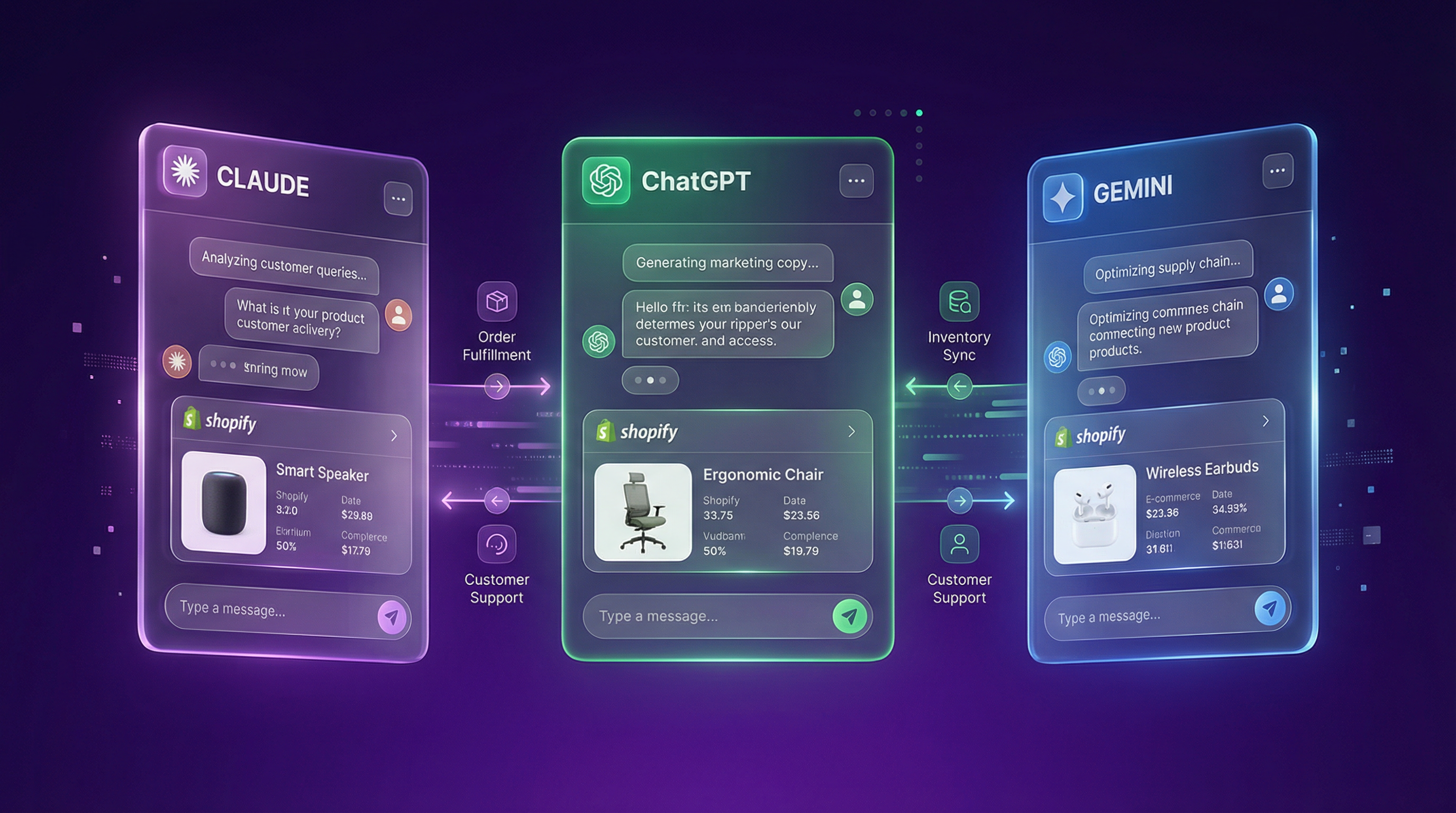

You want to use AI for your Shopify store — but which model do you choose? The short answer: Claude leads for product copy and brand voice, ChatGPT for versatile workflows and integrations, Gemini for the Google ecosystem and data analysis. The difference in real-world use is significant — and for Shopify merchants, there’s a clear ranking depending on the task. In this article, we walk you through real-world tests, concrete API cost breakdowns, and a compliance guide so you know exactly which model to use when.
The Three Models at a Glance
Before we get into the hands-on tests, here’s a quick breakdown of the three dominant AI models relevant to e-commerce and marketing.
Claude (Anthropic) – The Quality Writer
Claude is Anthropic’s model — a company founded by former OpenAI researchers with AI safety as its core mission. Claude 3.5 Sonnet and Claude 3 Opus are currently considered the best models for long-form, structured, high-quality text.
Strengths: Hits brand voice precisely, understands nuance, hallucinates less on fact-based tasks, excellent for long contexts (up to 200,000 tokens) Weaknesses: No web browsing by default (only via API tools), smaller plugin ecosystem, no native Office integrations
Especially relevant for Shopify merchants: Claude produces product descriptions that don’t feel AI-generated. No other model hits brand voice as consistently.
Pro tip: If you have a clear brand voice — premium, conversational, witty — give Claude a sample of your best product description as a reference. It’ll match that style with impressive precision, even across hundreds of texts.
ChatGPT (OpenAI) – The All-Rounder with an Ecosystem
ChatGPT is the most well-known model on the market. GPT-4o is the current flagship and offers a massive selection of Custom GPTs, plugins, and direct integrations with tools like Zapier, Make.com, and n8n.
Strengths: Massive ecosystem, best third-party integrations, native web browsing, code execution (Advanced Data Analysis), Custom GPTs for repeatable workflows Weaknesses: Tends toward marketing clichés in product copy, doesn’t maintain brand voice as consistently as Claude, higher API pricing for scaled use compared to Claude Haiku
Especially relevant for Shopify merchants: The broadest platform support of any model. If you’re building automations via n8n or Make.com, GPT-4o is the lowest-risk starting point.
Pro tip: Build a Custom GPT in ChatGPT with your brand voice, product categories, and most common tasks. Once configured, it’s your personal e-commerce assistant — no re-prompting every time you start a session.
Gemini (Google) – The Data Processor
Gemini is Google’s AI model — deeply integrated into Google Workspace, Google Ads, and Google Analytics. Gemini 1.5 Pro handles extremely large context windows (up to 2 million tokens) and can access Google data directly.
Strengths: Native Google integration (Docs, Sheets, Ads, Analytics), best multimodal capabilities (images + text), direct connection to Google Shopping and Search Console Weaknesses: Text quality behind Claude, relatively young ecosystem for third-party integrations
Especially relevant for Shopify merchants: If you run heavy Google Ads and Google Analytics workflows, the native integration is a genuine advantage. Gemini can analyze campaign data directly inside Google Sheets.
Pro tip: Enable Gemini in Google Workspace and ask it directly inside your Analytics sheet: “Which campaigns had the best ROAS over the last 30 days?” Gemini reads the data and answers in plain English — no export, no pivot table needed.
Hands-On Tests: Which Model Wins at Real E-Commerce Tasks?
We tested all three models with identical prompts. Here’s what we found — no sugarcoating.
Test 1: Writing a Product Description
Prompt: “Write a compelling product description for a premium handcrafted leather backpack, 30L, made in the USA, price $349. Target audience: urban professionals aged 28–45. Tone: premium, authentic, sustainable. 150 words.”
Product Description – Model Comparison
| Criterion | Claude | ChatGPT | Gemini |
|---|---|---|---|
| Tone matches brief | ⭐⭐⭐⭐⭐ | ⭐⭐⭐⭐ | ⭐⭐⭐ |
| Original phrasing | ⭐⭐⭐⭐⭐ | ⭐⭐⭐ | ⭐⭐⭐ |
| Respects word count | ⭐⭐⭐⭐⭐ | ⭐⭐⭐⭐ | ⭐⭐⭐⭐⭐ |
| Avoids marketing clichés | ⭐⭐⭐⭐⭐ | ⭐⭐⭐ | ⭐⭐⭐ |
| SEO keyword integration | ⭐⭐⭐⭐ | ⭐⭐⭐⭐⭐ | ⭐⭐⭐⭐ |
Test 2: Writing an Abandoned Cart Email
Prompt: “Write an abandoned cart email for a Shopify store selling premium coffee machines (avg. cart value $380). The customer left a ‘Barista Pro X’ in their cart. Tone: friendly, non-pushy, with a value-add element (e.g., a tip or recipe). No discount.”
Claude delivered an email with an authentic story-driven opening (“Your perfect morning is still waiting”), a genuine espresso tip as added value, and a CTA that didn’t feel like a CTA. ChatGPT wrote a functionally solid email but fell back on “Only a few left in stock!” — even though no scarcity signal was requested in the prompt. Gemini produced a technically correct but emotionally flat email with no discernible personality.
Our verdict for Klaviyo flows: Claude for emotion-driven flows (Welcome, Win-Back, Abandoned Cart). ChatGPT for structured, template-based flows with many variables. Combine both: Claude writes the copy, ChatGPT handles the logic.
Test 3: Analyzing Customer Reviews
Prompt: “Analyze these 5 customer reviews of a Shopify outdoor backpack store. Identify the most common pain points, suggest concrete product improvements, and give the store owner an action plan.”
Here the results were surprisingly clear: Gemini won this test. The structured analysis, prioritization of pain points by frequency, and concrete action items were sharper than the other models. Claude delivered strong results too, while ChatGPT’s recommendations lacked prioritization.
Our verdict: For analysis tasks — customer reviews, return reasons, support ticket analysis — Gemini is a serious contender, especially when data comes straight from Google Sheets.
Test 4: Optimizing Google Shopping Feed Titles
Prompt: “Optimize these 5 Google Shopping product titles for maximum CTR and relevance. Follow Google’s best practices: brand first, relevant keyword, product attributes (size, color, material).”
ChatGPT won this test clearly. The Custom GPT functionality and its transparent explanation of each optimized title made the difference. Claude was close behind; Gemini — despite its Google ties — came in third.
Test 5: Meta Ad Copy (5 Variations)
Prompt: “Write 5 different Facebook/Instagram ad texts for a new line of sustainable sneakers (price: $149). Target audience: eco-conscious Millennials, 25–38. Format: Hook (1 sentence), Body (2–3 sentences), CTA.”
All three models delivered solid results. Claude produced the most creative hooks and strongest emotional triggers. ChatGPT delivered the most balanced mix of performance-driven and brand-focused copy. Gemini tended to repeat similar hooks across all 5 variations.
Our verdict for Meta Ads: Claude for creativity and emotional differentiation. ChatGPT when you need quickly scalable A/B test variants.
Decision Matrix: Which Model for Which Use Case?
AI Model Recommendation by E-Commerce Use Case
| Use Case | Recommendation | Reason |
|---|---|---|
| Product descriptions (individual) | Claude | Best tone, no clichés |
| Product descriptions (bulk, 1,000+) | Claude Haiku API | 10x cheaper than GPT-4o, quality sufficient |
| Klaviyo flows (Welcome, Abandoned Cart) | Claude | Emotional copy, strong brand voice |
| Meta ad copy (creative) | Claude | Original hooks, emotional differentiation |
| Meta ad copy (A/B test variants) | ChatGPT | Quickly scalable, balanced variation |
| Google Shopping titles | ChatGPT | Best grasp of Google’s requirements |
| Customer review analysis | Gemini | Structured data analysis, Google Sheets integration |
| Google Analytics reporting | Gemini | Native Google integration, works in Sheets |
| SEO blog articles | Claude | Depth, structure, GEO optimization |
| n8n/Make automations | ChatGPT | Best ecosystem, most integrations |
| Customer service replies | Claude | Most empathetic phrasing, right tone |
| Strategy brainstorming | ChatGPT | Web access, most current market data |
| Return analysis / reporting | Gemini | Data processing from Google sources |
Cost Comparison: What Does AI Actually Cost a Shopify Merchant?
This is the section no one else makes this concrete — and for many merchants, it’s the deciding factor.
Consumer Plans: Free vs. Pro
All three models offer free tiers with limited usage and Pro plans at around $20/month. For individual team members, the Pro plan is often enough to get started.
API Costs: The Real Factor at Scale
Merchants who embed AI into workflows — for example, auto-generating product descriptions when new items are added — use the API. That’s where real costs show up.
API Cost Comparison: 1,000 Product Descriptions (~300 words output each)
| Model | Quality Tier | Input / 1M tokens | Output / 1M tokens | Cost for 1,000 texts |
|---|---|---|---|---|
| Claude 3 Haiku | Good (bulk) | $0.25 | $1.25 | ~$3–6 |
| Claude 3.5 Sonnet | Very good | $3.00 | $15.00 | ~$25–40 |
| GPT-4o mini | Good (bulk) | $0.15 | $0.60 | ~$2–5 |
| GPT-4o | Very good | $5.00 | $15.00 | ~$30–60 |
| Gemini 1.5 Flash | Good (bulk) | $0.075 | $0.30 | ~$1–3 |
| Gemini 1.5 Pro | Very good | $3.50 | $10.50 | ~$20–35 |
Recommendation by Store Size
Which AI model makes sense when?
| Store Stage | Annual Revenue | Recommendation | Reason |
|---|---|---|---|
| Starter Store | Under $100K | Claude Pro or ChatGPT Pro | $20/month, no API setup needed, productive from day one |
| Growth Store | $100K – $1M | Claude 3.5 Sonnet (API) + ChatGPT for automations | First workflows pay off, define and scale brand voice |
| Scale-Up | Over $1M | Claude Haiku (bulk) + Sonnet (premium) + Gemini (analytics) | Differentiated stack by task, maximum efficiency |
Need an AI strategy for your Shopify store?
Lass uns gemeinsam schauen, was wir für deinen Online-Shop herausholen können.
Integrating AI into Your Shopify Workflow: Three Concrete Setups
Picking the right model is one thing — integrating it into your daily workflow is another. Here are three concrete setups depending on your experience level.
Setup 1: Browser-Based (Beginners)
The easiest entry point: use Claude.ai, ChatGPT, or Gemini directly in the browser. You open the tool, enter your prompt, and copy the output into Shopify. For merchants with a small product catalog or occasional AI tasks, this is the right starting point.
Recommendation: Claude Pro ($20/month) for product descriptions and emails, ChatGPT Pro for research and strategy.
Tip: Save your best prompts in a Notion doc — sorted by task type (product copy, ad copy, email). That saves time every day and makes your AI setup shareable with your team.
Setup 2: Shopify Magic + AI Assistant Combined
Shopify built Shopify Magic directly into the admin — it works for quick product descriptions and email subject lines. Quality sits slightly behind Claude or GPT-4o, but it’s right there in your workflow, no tab switching.
Smart combo: Shopify Magic for quick first drafts in the admin → Claude for brand voice polish and refinement.
Setup 3: n8n / Make Automation with the Claude API (Advanced)
For Shopify merchants who want real scale: fully automated product description generation via n8n or Make.com.
Example workflow:
- New product added in Shopify (trigger)
- n8n reads product title, tags, and category
- Claude API generates description based on a stored brand voice prompt
- Description automatically written back to Shopify
This workflow runs fully hands-free, costs roughly $0.01–0.05 per product via Claude Haiku, and saves your team 5–15 minutes per item. At 100 new products per month, that’s up to 25 hours of team time saved.
Tip: You don’t need a developer for your first automations. n8n has a visual interface and a free self-hosted version. The workflow “New Shopify product → Claude → write description back” can be live in under two hours.
Make.com and n8n both have native connectors for Claude (Anthropic), ChatGPT (OpenAI), and Shopify. Claude is now just as well integrated as ChatGPT on both platforms.
Data Privacy & Compliance: What Shopify Merchants Need to Know
This is the question everyone asks — and barely any article answers concretely.
The fundamental rule: You may not enter any personally identifiable customer data (names, email addresses, order histories, IP addresses) into the consumer interfaces of Claude.ai, ChatGPT, or Gemini. These inputs may be used for model training — a privacy violation for any business handling customer data.
For tasks without personal data (product descriptions, ad copy, blog content) you can use the consumer plans freely.
Compliance Traffic Light: What’s Allowed?
| Use Case | Claude | ChatGPT | Gemini | Note |
|---|---|---|---|---|
| Product copy (no personal data) | ✅ Green | ✅ Green | ✅ Green | No personal data involved |
| Anonymized reviews analysis | ✅ Green | ✅ Green | ✅ Green | Only if names are removed |
| Customer data (email, orders) in consumer plan | 🔴 Red | 🔴 Red | 🔴 Red | Privacy violation — training not excluded |
| Customer data via API (with DPA) | ✅ Green | ✅ Green | 🟡 Yellow | DPA must be signed first |
The digitalsprung Verdict: Our Recommendation for E-Commerce Teams
After extensive testing, client projects, and live workflows, here’s our clear take:
For most Shopify merchants, we recommend Claude as the primary writing model. Text quality — especially for product descriptions, email flows, and ad copy — is consistently better. Brand voice stays recognizable even across a hundred texts in a row. That’s the factor that makes a long-term difference in e-commerce.
ChatGPT is the first choice for automation and workflows. If you’re using n8n or Make.com, need strategy research, or want to build Custom GPTs, ChatGPT is unmatched. The ecosystem is simply in a different league.
Gemini is underrated — for analytics tasks. Merchants running heavy Google Ads and Google Analytics workflows should give Gemini a serious look. The data analysis capabilities are impressive and keep growing.
Our starter recommendation: Begin with Claude Pro ($20/month) for product copy and emails. Run ChatGPT Pro in parallel for research and strategy. Switch to API usage once you’re regularly generating more than 50 texts per month.
Frequently Asked Questions
Claude (Anthropic) is our clear pick for product descriptions. The copy sounds more natural, maintains brand voice more consistently, and avoids marketing clichés better than ChatGPT or Gemini. For bulk generation (500+ products), we recommend Claude Haiku via API — the quality is more than sufficient and costs up to 10x less than GPT-4o.
For emotion-driven email flows (Welcome Series, Abandoned Cart, Win-Back), Claude is the stronger choice. The copy has more depth, hits tone more precisely, and sounds less templated. ChatGPT makes more sense when you need lots of structured variants for A/B testing, or when building automations via n8n or Make.com.
For tasks without personal data (product copy, ad copy, blog content), all consumer plans (claude.ai, ChatGPT, Gemini) are fine to use. The moment you're working with customer data — orders, email addresses, purchase history — you need the API with a signed Data Processing Agreement (DPA). Both Anthropic (Claude) and OpenAI (ChatGPT) offer DPAs and don't train on API data.
Start with Claude Pro ($20/month) for product descriptions, emails, and ad copy. Add ChatGPT Pro for research, strategy, and anything Google Shopping-related. You don't need an expensive enterprise stack — with $40/month (two Pro plans), you can cover 80% of all AI tasks in e-commerce.
There are three ways: 1) Directly in the browser (easiest entry point), 2) Shopify Magic (AI built into Shopify Admin) combined with Claude/GPT for refinement, 3) Full automation via n8n or Make.com using the Claude API or OpenAI API. With option 3, new products can automatically receive descriptions with zero manual effort.
Using Claude Haiku (API), generating 1,000 product descriptions at ~300 words each costs roughly $3–6. GPT-4o Mini is similar ($2–5), Gemini Flash is even cheaper ($1–3). Premium models (Claude Sonnet, GPT-4o) run $25–60. For bulk tasks, we recommend the budget models — quality is completely sufficient for standard product copy.
Gemini is especially strong for analytics tasks with Google data: Google Ads analysis, Google Analytics reports, Google Shopping feed optimization directly from Google Sheets. For pure writing, Gemini sits behind Claude and ChatGPT. As a complement in your stack — not as your primary model — Gemini makes real sense for Shopify merchants with a heavy Google marketing focus.
We use Claude as our primary writing model for product copy, blog articles, and email flows in client projects. For automation and workflow setup, we rely on ChatGPT (OpenAI API) combined with n8n. Gemini comes into the mix for data-driven analysis from Google ecosystems. There's no fixed 'winner takes all' stack — we choose based on the task at hand.
This article is updated quarterly. Last updated: March 2026. The AI model landscape moves fast — we’ll keep you current.