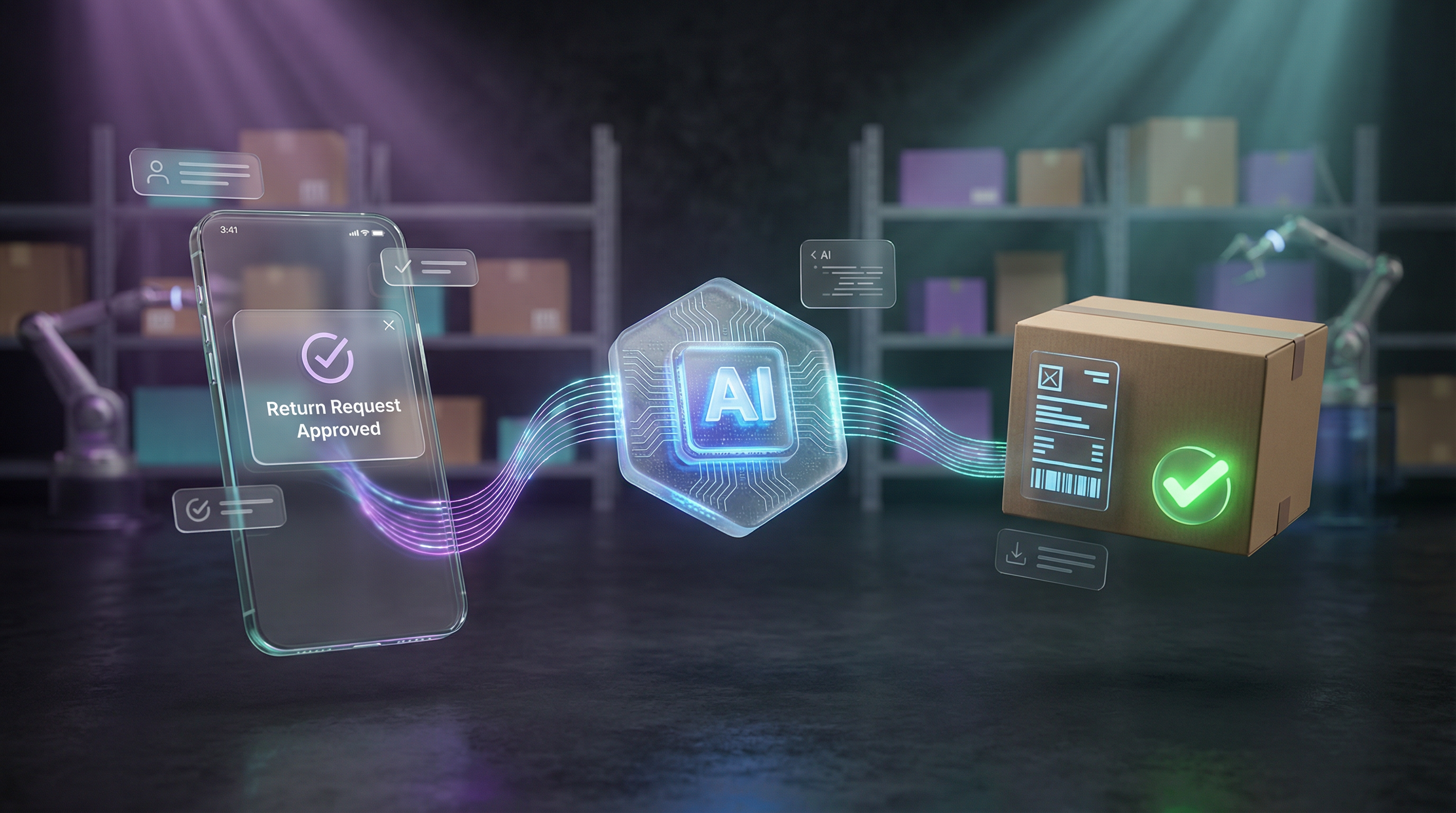

Americans returned over $890 billion worth of merchandise in 2024 — roughly 16.9% of total retail sales (NRF & Happy Returns, 2025). Every single return costs retailers between $10 and $30 to process. But here’s the kicker: the majority of those costs aren’t in the warehouse — they’re in customer service. Answering emails, verifying eligibility, generating prepaid shipping labels, communicating status updates, and triggering refunds.
Yet only a small fraction of US online retailers use AI in their returns management today — even though most consider it highly relevant. The gap between knowing and doing is your competitive advantage.
This guide shows you exactly how to automate return requests from start to finish — from the first customer message to the automated refund — with a complete AI workflow, concrete ROI numbers, US tool recommendations, and a realistic roadmap for SMBs.
What Every Manual Return Actually Costs You
Before we talk automation, let’s do the honest math. Most merchants dramatically underestimate the true cost of a single return.
Direct Costs
The obvious cost line items per return:
- Customer service time: 6–15 minutes per request (read email, verify eligibility, generate label, reply) at $18–$35/hour = $1.80–$8.75 per return
- Outbound return shipping: $8–$15 per package depending on carrier agreement (retailers typically absorb 60–80%)
- Inspection and restocking: 5–15 minutes of warehouse labor = $1.50–$5.00
- Loss of value: 15–35% of item price from reverse logistics, refurbishment, or liquidation
Hidden Costs
What rarely shows up in the spreadsheet, but hits just as hard:
- Capital lockup: Returned merchandise sits in transit or inspection for 7–21 days — unavailable for resale
- Customer churn: 26% of shoppers who have a bad returns experience won’t buy from that retailer again (Sendcloud Returns Report 2024)
- Return fraud: An estimated 13.7% of all returns in the US involve some form of fraud — worn apparel, missing items, wrong products (NRF 2024)
- Employee burnout: Processing repetitive return requests is consistently rated among the most demoralizing tasks in eCommerce customer service
Return Rates by Industry
| Industry | Average Return Rate | Estimated Cost per Return |
|---|---|---|
| Apparel & Fashion | 30–50% | $15–$25 |
| Consumer Electronics | 25–35% | $20–$45 |
| Furniture & Home Goods | 8–15% | $30–$80 |
| Books & Media | 5–10% | $4–$10 |
| eCommerce Average | 16–18% | $10–$30 |
What AI Can (and Can’t) Do in Returns Management
AI isn’t a silver bullet. But deployed in the right context, it fundamentally changes how returns work. The key is understanding the three tiers of AI involvement.
Tier 0: AI Prevents Returns (Prevention)
This is the most underestimated lever — and the most profitable. The best return is the one that never happens.
How AI actively prevents returns:
- Size and fit advisors: AI analyzes customer measurements, reviews from similar buyers, and product specifications to give personalized size recommendations. Result: up to 25% fewer size-related returns
- Product description optimization: AI flags products with above-average return rates and identifies misleading or incomplete descriptions as the likely cause
- Return fraud detection: AI models score the fraud risk of every order in real time — based on customer history, order patterns, IP data, and behavioral signals
- Purchase hesitation detection: AI identifies customers who buy while unsure and triggers proactive chat assistance — before they check out and later regret it
Tier 1: AI Automates the Customer Request
From the moment a customer submits a return request, the AI agent takes over:
- Omnichannel: Email, SMS, live chat, helpdesk tickets — the AI agent works all channels simultaneously
- 24/7 instant response: Reply within seconds, not hours
- Multilingual: Automatic language detection, responses in English, Spanish, French, and more
- Context-aware: The agent already knows the order number, product details, return window, and customer history — no need to ask the customer to repeat themselves
Tier 2: AI Makes the Return Decision
This is where the biggest savings are: automated eligibility checks and approvals.
- Eligibility verification: Is the return window still valid? Is the item returnable? Has this customer filed an unusually high number of returns?
- Automatic label generation: For approved returns, the system immediately generates a prepaid shipping label and sends it via email
- Custom goodwill rules: Configurable exceptions for VIP customers or edge cases
- Fraud escalation: High-risk returns get routed to manual review instead of being automatically approved
Tier 3: AI Manages Logistics and the Refund
Once the package arrives at your warehouse:
- Automatic delivery confirmation via email or SMS to the customer
- AI-powered disposition: Resalable, refurbish, liquidate, or discard? AI classifies items based on photos and product data
- Automatic refund trigger: As soon as receipt is confirmed, the refund or store credit is issued — no manual approval needed
- CRM update: Return status and reason are automatically logged in the customer profile
Where AI Still Has Limits
Honesty matters here. Some aspects still require a human touch:
- Physical quality inspection of returned merchandise (scratches, damage, missing components)
- Complex goodwill decisions in unusual cases
- Emotionally charged escalations where customers need a human to feel heard
The Complete AI Returns Workflow — Step by Step
Here’s the end-to-end process we implement for SMBs in practice — from first contact to closed case:
Step 1: Customer Submits Request (Email, SMS, Chat)
The customer writes: “I’d like to return order #12345 — the jacket doesn’t fit.”
What the AI agent does:
- Reads and understands the request (NLP)
- Looks up the order number in the store system (API call to Shopify/BigCommerce/WooCommerce)
- Retrieves order details: purchase date, item, return window, customer history
Time: < 3 seconds
Step 2: Verify Eligibility
The AI agent automatically checks:
- Is the standard 30-day return window still open? ✓
- Is this item eligible for return (no final sale exceptions)? ✓
- Has this customer filed more than X returns in the last 6 months? → Risk flag
- Is there a fraud indicator present? → Escalate to human
Outcome: Approved / Denied / Escalated
Step 3: Communication and Label Delivery
Upon approval:
- Automatic email/SMS reply with personalized return instructions
- UPS/FedEx/USPS prepaid return label as a PDF attachment (API integration)
- Return tracking number for the customer
- Expected processing timeframe communicated clearly
Time: < 30 seconds after initial request
Step 4: Receiving and Disposition
Once the package scans at your warehouse:
- Automatic confirmation email to the customer
- AI classification: A-stock, B-stock, or special handling
- Warehouse management system updated automatically
Step 5: Automatic Refund or Store Credit
- Refund: Automatic trigger to your payment processor (Stripe, PayPal, Affirm, Klarna) within defined SLAs
- Store credit option: For customers showing purchase intent, offer store credit with a small bonus (increases repurchase rate by up to 34%)
- Closing communication: Refund confirmation with processing timeline
ROI Calculator: What Does AI Automation Actually Get You?
Example: Small Store (50 Returns/Month)
| Item | Manual | With AI |
|---|---|---|
| Processing time | 50 × 8 min = 6.7 hrs | 50 × 0.5 min = 0.4 hrs (exceptions only) |
| Labor cost ($25/hr) | $167/month | $10/month |
| AI tool cost | — | $150–$250/month |
| Net effect | –$167 | –$160 to –$260 |
Takeaway for small stores: At 50 returns/month, pure labor savings don’t justify the cost alone. The real value is 24/7 availability, faster resolution times (customer satisfaction), and scalability — you can double your order volume without adding headcount.
Example: Mid-Size Store (300 Returns/Month)
| Item | Manual | With AI |
|---|---|---|
| Processing time | 300 × 8 min = 40 hrs | 300 × 0.5 min = 2.5 hrs (exceptions only) |
| Labor cost ($25/hr) | $1,000/month | $63/month |
| AI tool cost | — | $300–$500/month |
| Monthly savings | — | $437–$637 net |
| Annual savings | — | $5,244–$7,644 |
| Implementation cost | — | $8,000–$18,000 |
| Break-even | — | 13–26 months |
Example: Large Store (1,000+ Returns/Month)
At 1,000 returns/month, AI automation saves $2,500–$4,500 monthly — break-even in 3–6 months. Add another 10–15% reduction in return volume through Tier 0 prevention and the numbers get even better.
Your Personalized ROI Calculator
Run the numbers for your own situation:
ROI-Rechner
Was spart KI Ihrem Unternehmen wirklich?
Wählen Sie Ihre Branche – Werte werden vorausgefüllt. Alle Felder sind anpassbar.
Branche auswählen
Tickets, Chats, Bewerbungen oder Rechnungen
Inkl. Arbeitszeit, Overheads, Fehlerkosten
Branchendurchschnitt: 60–80 %
Lizenz + API-Kosten + Betrieb
Setup, Integration, Schulung
Ihre Eingaben
Anfragen × % × €
= Brutto-Ersparnis pro Monat
€
Brutto-Ersparnis / Monat
Vor Abzug der KI-Kosten
Netto-Ersparnis / Monat
Nach Abzug lfd. KI-Kosten
Break-Even
Monat
Kein Break-Even
Bis Implementierung amortisiert
ROI nach 12 Monaten
Auf Gesamtinvestition (inkl. Implementierung)
* Richtwerte basierend auf Branchenbenchmarks (Stand 2026). Tatsächliche Ergebnisse hängen von Implementierungsqualität, Datenqualität und Unternehmenskontext ab. 35 % der KI-Projekte erreichen den Break-Even nicht – Planung und Ownership sind entscheidend.
The Best AI Returns Tools for US-Based Online Retailers
No article in the English-language market gives you a straight answer here. This is our honest assessment — based on real implementations.
Specialized Returns Platforms
| Tool | Strengths | Shopify | BigCommerce | Privacy | Starting Price |
|---|---|---|---|---|---|
| Loop Returns | Shopify-native, exchange-first, smart rules | ✅ | ✅ | ✅ SOC 2 | ~$59/mo |
| Happy Returns | In-person drop-off network, no box needed | ✅ | ✅ | ✅ | Custom |
| AfterShip Returns | Multi-carrier, analytics, automation rules | ✅ | ✅ | ✅ | ~$23/mo |
| Returnly | Instant refund before return arrives | ✅ | – | ✅ | Custom |
| 8returns | European origin, strong analytics, DE hosting | ✅ | ✅ | ✅ GDPR | ~$199/mo |
AI Agents for Omnichannel Customer Service
| Tool | Strengths | Channels | Privacy | Starting Price |
|---|---|---|---|---|
| Gorgias AI | eCommerce-native, deep Shopify integration | Email, chat, SMS | ✅ SOC 2 | ~$10/mo |
| Tidio AI | Easy setup, live chat + email, SMB-friendly | Chat, email | ✅ GDPR | ~$29/mo |
| Zendesk AI | Enterprise-grade, deep integrations | All channels | ✅ SOC 2 | ~$55/mo |
| octonomy.ai | European, eCommerce-focused, Shopify integration | Email, chat | ✅ EU hosting | Custom |
Workflow Automation (for Custom Solutions)
For stores that want to build a fully tailored returns workflow:
- n8n (Open Source, self-hosted) — maximum flexibility, ideal for data privacy compliance
- Make (formerly Integromat) — fast implementation, dozens of native connectors
- Zapier — easiest setup, limited flexibility for complex branching logic
Prerequisites — The Honest Checklist for SMBs
One of the most common mistakes: buying a tool before your foundation is solid. Check these boxes before you invest:
Technical Prerequisites
- Digital order data: Orders live in a system (Shopify, BigCommerce, WooCommerce, your ERP) — not spreadsheets
- API access: Your store platform has an open API (standard on all major platforms today)
- Email integration: Inbound return requests route to a defined inbox or helpdesk
- Historical data: At least 3 months of returns history with documented reasons
- Carrier API: UPS, FedEx, or USPS has an API connection for automated label generation
Process Prerequisites
- Documented return policy: Who decides what, when, and based on which rules?
- Reason taxonomy: Do you have defined return reason categories? (Size, quality, shipping damage, wrong item)
- Window definitions: What windows apply? (Standard 30 days? Extended holiday return windows?)
- Escalation rules: Which cases always go to a human?
- Goodwill rules: When is goodwill extended, and for which customer segments?
What a Project Costs
| Project Type | Timeline | One-Time Cost | Ongoing Cost |
|---|---|---|---|
| Self-service returns portal | 1–2 weeks | $1,500–$5,000 | $150–$350/mo |
| AI agent (email + chat) | 3–6 weeks | $5,000–$15,000 | $300–$700/mo |
| Full end-to-end AI automation | 6–12 weeks | $15,000–$40,000 | $600–$1,500/mo |
Privacy and Compliance — What US Online Retailers Need to Know
This is the section most guides skip. It’s also the one that can cost you the most if you get it wrong.
When Does Returns AI Count as “Profiling”?
If your AI system makes automated decisions that have significant effects on individuals — like automatically denying a return or flagging a customer as fraudulent — this can trigger legal obligations under CCPA (California) and GDPR (if you serve EU customers).
Practical implication: Customers should always have a path to human review. The fix is simple: every automated denial includes the message: “Think this decision was made in error? Contact our support team to request a manual review.”
GDPR Considerations for US Merchants Serving European Customers
If you sell to EU customers, GDPR applies to you regardless of where your company is incorporated. Key obligations:
- Data Processing Agreements (DPAs): Required with every AI tool that processes EU customer data
- Transparency: Inform customers in your privacy policy that AI is used in the returns process
- Right to human review: Required under Article 22 GDPR for fully automated individual decisions
- Data minimization: Don’t collect and store more customer data than your AI system actually needs
CCPA Considerations for California Merchants
Under the California Consumer Privacy Act:
- Customers have the right to know what personal data you collect and how it’s used — including in automated return decisions
- They have the right to opt out of the “sale” of their personal data (relevant if your AI tool shares data with third parties)
- Document your AI tool’s data flows in your privacy policy
Real-World Case Studies
Case Study 1: Fashion SMB, Shopify, 300 Returns/Month
Starting point: Family-owned business, 14 employees, 42% return rate on apparel, two part-time staff members manually processing returns, average handling time 11 minutes per request.
Solution: AI agent for email and chat (Gorgias AI + n8n workflow) + AfterShip Returns self-service portal. Shopify integration via API.
Results after 3 months:
- 74% of return requests fully automated
- Average response time: from 4.5 hours down to 38 seconds
- Two part-time team members redeployed to higher-value tasks
- Monthly savings: $1,100 (labor + tool costs netted out)
- Break-even: 12 months
Case Study 2: Electronics Retailer, WooCommerce, 80 Returns/Month
Starting point: B2B-focused merchant, 7 employees, complex returns (technical defects, warranty claims), high manual review burden.
Solution: AI triage system: AI automatically classifies requests (standard return vs. warranty claim vs. defect) and routes them accordingly. Only standard cases are fully automated (38% of all cases).
Results:
- 38% fully automated, 62% handled faster manually (AI pre-fills everything)
- Manual handling time cut in half: from 18 to 9 minutes per case
- Customer satisfaction (CSAT): from 3.2 to 4.1 out of 5
“The biggest surprise wasn’t the time savings — it was that our customers finally got an instant response. That single change improved our reviews and NPS scores dramatically.”
5-Step Roadmap to AI Returns Automation
Step 1: Current State Analysis (Week 1–2)
Document your existing returns process in full:
- How many returns per month?
- Through which channels do requests come in? (Email, phone, chat, social DMs)
- How long does each request take on average?
- What are the top return reasons? (Pull 100 recent cases manually)
- Which cases regularly escalate?
Step 2: Audit Your Data and Systems (Week 2–3)
Check your technical readiness:
- Does your store platform have API access? (Test: can you pull order data via API?)
- Does your carrier have an API? (UPS Developer Kit, FedEx Web Services, USPS Web Tools)
- Which system will serve as your single source of truth?
Step 3: Define Your Pilot and Choose Your Tool (Week 3–4)
Don’t start with the most complex case. Recommended entry point:
- Set up a self-service returns portal (Loop Returns or AfterShip)
- Automate only clean approvals (window valid, item eligible)
- Keep all exceptions running manually for now
This alone cuts your workload by 40–60% immediately — with virtually no risk.
Step 4: Integrate and Test (Week 4–8)
- Connect your returns platform to your store system (API)
- Run 50–100 real cases in parallel (AI and manual simultaneously)
- Measure: error rate, automation rate, customer feedback
- Only switch off manual process after successful parallel testing
Step 5: Expand to Full AI Agent (Month 2–3)
Once the portal is stable, layer in the AI agent for inbound requests:
- Set up email automation
- Connect SMS if relevant for your customer base
- Add Tier 0 prevention (size advisor, fraud detection)
Returns Automation Readiness Checklist for SMBs
Technical & process prerequisites + 5-step implementation roadmap · ki-agentur.com
Technical Prerequisites
- Order data lives in a system (Shopify, BigCommerce, WooCommerce, ERP) — not spreadsheets
- Your store platform has an open API for order data retrieval
- Inbound return requests route to a defined inbox or helpdesk ticketing system
- At least 3 months of returns history with documented return reasons
- Carrier API available (UPS, FedEx, or USPS) for automated label generation
Process Prerequisites
- Return process fully documented (who decides what, when, and based on which rules)
- Return reasons categorized (size, quality, shipping damage, wrong item, etc.)
- Return windows defined (standard 30 days + any extended holiday or goodwill windows)
- Escalation rules defined (which cases always go to a human)
- Goodwill rules defined (when and for which customer segments)
5-Step Implementation Roadmap
- Step 1: Current-state analysis — pull 100 recent returns, log reason, channel, and handling time
- Step 2: Audit data & systems — test API access, define single source of truth
- Step 3: Pilot project — set up a self-service portal (Loop Returns / AfterShip), automate standard approvals only
- Step 4: Integrate & test — run 50–100 real cases in parallel; only switch off manual after successful test
- Step 5: Layer in AI agent — email automation, SMS, Tier 0 prevention (size advisor, fraud detection)
Privacy & Compliance Checklist
- Data Processing Agreements (DPAs) signed with all AI tool vendors
- Privacy policy updated to disclose AI use in the returns process
- Automated denials include a path to human review (required under GDPR Art. 22 for EU customers)
- Data residency verified for tools handling EU customer data
Get a Free Returns Process Analysis
We'll review your current returns workflow and show you in 45 minutes exactly where AI delivers the biggest impact — no sales pitch, completely free.
FAQ — Common Questions About AI Returns Automation
As a rule of thumb: automating customer service (answering requests, generating labels) pays off at around 150–200 returns per month. At lower volumes, a self-service returns portal (Loop Returns, AfterShip) still cuts per-return handling time in half — even without a full AI agent behind it. Break-even for those entry-level solutions is typically 2–6 months.
A self-service returns portal is live in 1–2 weeks. A full AI agent with email automation takes 4–8 weeks — assuming your store platform has an open API and your return process is documented. A complete end-to-end automation including logistics integration and automated refund triggers takes 8–16 weeks.
Yes — for rule-based checks, with near-100% accuracy. AI checks in seconds: Is the return window still open? Is the item eligible based on your policy? Has the customer met the stated return conditions? For gray areas (damaged goods, disputed situations), it escalates to a human. Typical automation rates land between 65–80% of all requests.
Yes, when set up correctly: (1) Data Processing Agreements with all AI tool vendors, (2) Privacy policy updated to disclose AI use in the returns process, (3) For automated denials, customers must have a clear path to human review (required under GDPR Article 22), (4) Prefer tools with US or EU data residency options. Tools like Loop Returns, AfterShip, and Gorgias AI offer enterprise privacy compliance.
For Shopify, Loop Returns is the gold standard — it's built specifically for Shopify, offers exchange-first flows, and integrates deeply with your store data. For the AI agent layer, Gorgias is the top pick with native Shopify integration. If you want a custom workflow with full control, n8n (self-hosted) gives you maximum flexibility at minimal ongoing cost.
Yes — and this is one of the most underappreciated benefits. AI analyzes in real time: return frequency per customer, patterns between purchase and return timing, unusual product combinations, mismatch between item value and return reason, and behavioral anomalies. Systems like Signifyd report 85–92% fraud detection accuracy. Flagged returns are escalated to manual review — they're never automatically denied.
Ongoing costs break down as: Tool license ($150–$600/month depending on volume and tool), carrier API costs for label generation (~$0.10–$0.30 per label), and AI API costs (usually bundled into the tool). Total for a mid-size store (200–500 returns/month): $300–$800/month. One-time implementation: $5,000–$18,000.
Not for standard solutions. Loop Returns, AfterShip, and similar platforms offer native Shopify and BigCommerce plugins that are up and running in a few hours. For more complex AI agent implementations — custom routing logic, multi-system integrations, custom fraud models — working with an AI agency to handle setup and knowledge transfer is the smarter call. Ongoing maintenance after go-live is minimal: typically 1–2 hours per month.
Three mechanisms: (1) Instant response instead of waiting hours — 84% of customers rate response speed as the most important quality signal in support. (2) Clear next-step communication — the AI agent always tells the customer what happens next and by when. (3) Seamless handoff — when the AI can't resolve something, it transfers to a human with full context already loaded. Customers notice the handoff, but they're never asked to repeat themselves.
Four proven approaches: (1) AI size and fit advisor reduces apparel returns by up to 25%. (2) Product description analysis flags items with above-average return rates and identifies the most common reasons — enabling better descriptions, photos, and sizing charts. (3) Early fraud detection reduces fraudulent returns by 30–60%. (4) Pre-purchase chat assistance prevents regret-driven buys. These add almost no cost when an AI system is already running.
Conclusion: Three Things You Can Start This Week
Automating return requests isn’t a future project — it’s an efficiency project that most online retailers can execute in 4–8 weeks. The technology is mature, the tools are accessible for SMBs, and the ROI math is transparent.
What you should do right now:
- Start your current-state analysis: Pull 100 recent return cases and categorize reasons and handling times — 2–3 hours of work that gives you the data foundation for every decision that follows
- Test a self-service portal: Set up Loop Returns or AfterShip on a 30-day free trial — no code, no dev team required
- Bring in an expert: For the full AI workflow (AI agent, API integration, compliance review), external guidance pays for itself — a bad setup costs more than the consulting
Sources
-
National Retail Federation & Happy Returns – Consumer Returns in the Retail Industry 2024/2025: $890B in merchandise returned; 16.9% return rate. nrf.com/research
-
Sendcloud – Returns Compass 2024: 26% of customers won’t buy again after a poor returns experience. sendcloud.com/returns-compass
-
National Retail Federation – Return Fraud 2024: 13.7% of all returns involve some form of fraud. nrf.com/research/consumer-returns-retail-industry-2024
-
IBM – AI-Based Returns Prediction in eCommerce (2020). ibm.com/think/topics/ai-returns-management
-
European Union – Regulation (EU) 2024/1689 (EU AI Act), Article 4 (AI Literacy), in effect since February 2, 2025. eur-lex.europa.eu/legal-content/EN/TXT/?uri=OJ:L_202401689
-
Shopify – State of Commerce 2024: eCommerce returns trends and cost benchmarks. shopify.com/research