

When your consultant says “we need an AI agent,” and your IT service provider simultaneously recommends “RPA is perfectly sufficient” — who’s right?
Both. And neither. Because the question is framed wrong.
RPA and Agentic AI solve fundamentally different problems. Confusing the two means either buying expensive AI for simple click-automations — or struggling for years with brittle RPA bots where an AI agent would handle the same work in hours.
This article gives you the tools you need: a decision matrix with 8 criteria, a cost comparison with real numbers, a step-by-step migration guide — and an EU AI Act breakdown that no other article covers in this depth.
What Is RPA — and Where Does It Break Down?
Robotic Process Automation (RPA) automates rule-based, structured processes by mimicking human click actions on user interfaces. An RPA bot sees the same screens as an employee, clicks the same buttons, and copies data from field A to field B.
RPA Strengths
- No API required: Works directly on existing GUIs — ideal for legacy systems without open interfaces
- Predictable: Deterministic execution; same input → always the same output
- Audit-ready: Every step is logged, suitable for compliance requirements
- Fast deployment: Typical implementation takes 2–8 weeks for a single process
Classic RPA Use Cases for SMBs
| Process | Typical Time Savings |
|---|---|
| Processing incoming invoices | 4–6 min/invoice → 30 sec |
| Syncing order status from ERP to CRM | 8 min → fully automated |
| Monthly reporting export | 3 hours → 15 minutes |
| Creating new vendor master data | 20 min → 2 min |
Where RPA Regularly Fails
Structural changes: The moment a supplier changes their invoice template, the bot breaks. No learning, no adapting — manual intervention required.
Unstructured data: Emails, PDFs without fixed fields, free-text form entries — RPA can’t handle these without a preceding OCR extraction layer.
Exceptions and decisions: If 20% of cases require an exception rule, RPA either throws errors or results in an unmaintainable decision tree with hundreds of if-then branches.
System updates: Any UI change in SAP, Dynamics, or online banking breaks the bot. Maintenance costs are systematically underestimated.
What Is Agentic AI — and Why Is It More Than a Chatbot?
An AI agent (Agentic AI) is an autonomous system that understands a goal, plans independently, uses tools, and learns from feedback. The critical difference from a traditional chatbot: the agent acts — it doesn’t wait for the next user input.
The 4 Core Capabilities of an AI Agent
1. Reasoning & Planning The agent automatically breaks down a high-level goal into sub-steps. “Draft a proposal for client XY” → agent checks CRM data, pulls the current price list, considers client history, drafts the text.
2. Tool Use Agents can call tools in a structured way: web search, database queries, API calls, code execution, email delivery. The LLM intelligence decides which tool makes sense when.
3. Adaptive Execution When step 3 fails (API doesn’t respond, data is missing), the agent replans — without manual intervention. RPA would terminate with an error at this point.
4. Context Memory Across a conversation or task, the agent retains relevant information: prior decisions, user preferences, project status.
Multi-Agent Systems: The Next Evolution
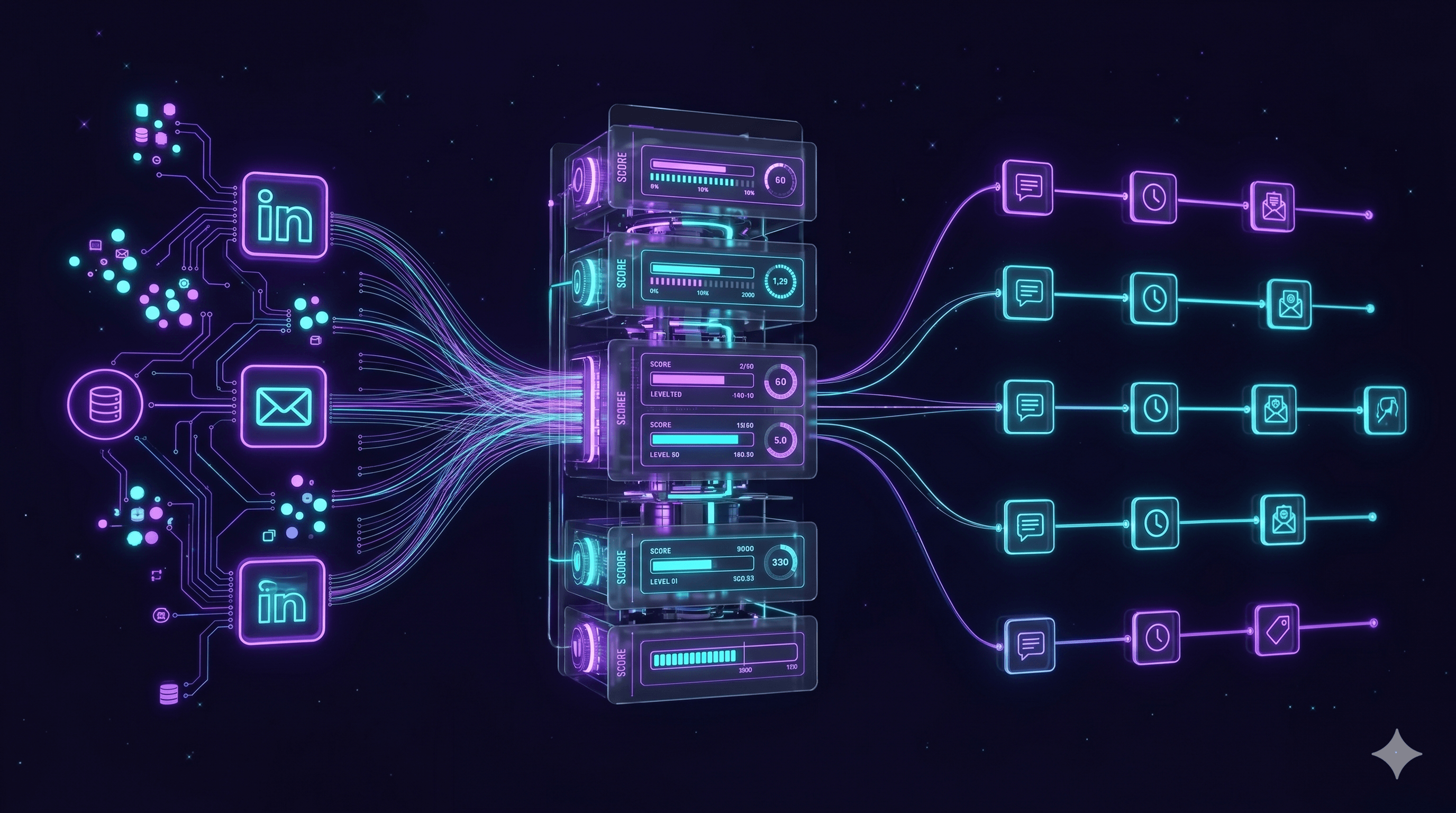
Complex business processes today aren’t handled by a single agent, but by teams of specialized agents: an orchestrator coordinates, a research agent retrieves data, an analysis agent processes it, a communication agent drafts the output.
This sounds complex — but in modern frameworks (Claude Agents, LangGraph, CrewAI) it’s implementable in days, not months.
Decision Matrix: RPA or AI Agent — 8 Criteria
| Kriterium | RPA | KI-Agent | Hybrid | Hinweis |
|---|---|---|---|---|
| Strukturierte Eingabedaten | | | | RPA optimal bei 100 % strukturierten Daten |
| Komplexe Entscheidungen | | | | Ab ~15 Regeln: KI-Agent klar überlegen |
| Legacy-Systeme ohne API | | | | RPA arbeitet direkt auf GUI |
| Häufige Prozessänderungen | | | | RPA bricht bei UI-Änderungen |
| Unstrukturierte Daten (E-Mails, PDFs) | | | | LLM versteht Freitext nativ |
| Compliance & Auditierbarkeit | | | | RPA: deterministisch; KI: Human-in-Loop nötig |
| Skalierungskosten | | | | RPA-Lizenzen steigen linear mit Volumen |
| Time-to-Value | | | | RPA-Quick-Wins in 2–4 Wochen möglich |
- › SAP/ERP oft ohne vollständige API (→ RPA für GUI-Anbindung)
- › Variierende Lieferantendokumente (→ KI für Dokumentenverständnis)
- › Stabile Kernprozesse + Ausnahmen bei Sonderaufträgen
- › Strukturierte Belege: RPA optimal
- › Sonderbelege, Freitexte: KI-Agent
- › Hohe Compliance-Anforderungen → deterministische Kernprozesse via RPA
- › Hohe Varianz bei Kundenanfragen und Reklamationen
- › Dynamische Preisanpassung und Produktempfehlungen
- › API-basierte Plattformen (Shopify, WooCommerce) gut LLM-zugänglich
- › Hunderte verschiedene Frachtbrief-Formate
- › Echtzeit-Entscheidungen (Routenoptimierung, Kapazität)
- › Kommunikation mit Partnern in natürlicher Sprache
- › Sehr hohe Compliance-Anforderungen (BaFin, DSGVO)
- › Deterministische Buchungsprozesse → RPA
- › KI nur mit vollständiger Auditierbarkeit und menschlicher Freigabe
- › Vollständig API-basierte Systeme
- › Häufige Produkt-Updates → RPA würde ständig brechen
- › Schnelle Skalierung ohne Lizenzkosten
The matrix covers the 8 most important decision dimensions. Here are the explanations:
Criterion 1: Structured Input Data
RPA wins with fully structured data — fixed fields, defined format, no exceptions.
AI agent wins with semi-structured data (emails, PDFs with variable structure, natural language requests).
Rule of thumb: If a new employee needs 30 minutes of onboarding to execute the process without errors → RPA. If they need a week of experience to handle exceptions reliably → AI agent.
Criterion 2: Decision Complexity
RPA: Up to 15–20 if-then rules are manageable. Beyond that, maintenance costs explode.
AI agent: Can make complex, multi-level decisions — without explicit rule formulation, based on contextual understanding.
Criterion 3: Frequency of Process Changes
Process changes less than once per quarter → RPA is economical. Structure, exceptions, or system environment change frequently → AI agent pays off through lower maintenance costs.
Criterion 4: Compliance Requirements
Criterion 5: Integration Complexity
RPA: Perfect for legacy systems without APIs. No changes to existing software needed.
AI agent: Prefers API-based integrations. For legacy environments, combining with RPA as the “hand” of the agent often makes sense (more below).
Criterion 6: Scalability
RPA: Horizontal scaling through more bot licenses — linear cost increase.
AI agent: API-based scaling without license overhead. Cost structure is often more favorable at high volume.
Criterion 7: Time-to-Value
RPA: 2–8 weeks for a stable process. Good for fast quick-wins.
AI agent: 2–6 weeks for MVP, then iterative expansion. Slightly more upfront effort, but less maintenance debt.
Criterion 8: Internal Skill Requirements
RPA: No coding skills needed (with no-code tools). Business analysts can model processes themselves.
AI agent: Requires AI expertise for prompt engineering, tool definition, and testing. Either internal upskilling or an external partner is needed.
Cost Comparison and ROI Example
Concrete numbers for a typical SMB (100–500 employees, manufacturing or services):
Example: Processing Order Confirmations (200 per week)
Starting point: 2 employees each spend 8 hours/week on manual data reconciliation between email, ERP, and CRM. Hourly cost including overhead: $42/h.
Current costs: 2 × 8 × 42 × 50 weeks = $33,600/year
Option A: RPA Solution
| Item | Cost |
|---|---|
| Implementation (external) | $18,000–$30,000 |
| RPA license/year (UiPath/Automation Anywhere) | $10,000–$18,000 |
| Maintenance & support/year | $3,500–$6,000 |
| Total Year 1 | $31,500–$54,000 |
| Ongoing costs/year | $13,500–$24,000 |
Automation potential: ~70% of manual work (exceptions remain manual). Net savings Year 1: $23,520 – $31,500 to $54,000 = minimal to negative From Year 2: $23,520 savings – $13,500 to $24,000 costs = $0–$10,000 net
Option B: AI Agent Solution
| Item | Cost |
|---|---|
| Implementation (external) | $15,000–$24,000 |
| API/infrastructure/year | $2,800–$7,200 |
| Maintenance & further development/year | $2,400–$4,800 |
| Total Year 1 | $20,200–$36,000 |
| Ongoing costs/year | $5,200–$12,000 |
Automation potential: ~85–90% (AI agent handles exceptions too). Net savings Year 1: $28,560 – $20,200 to $36,000 = neutral to moderately positive From Year 2: $28,560 savings – $5,200 to $12,000 costs = $16,560–$23,360 net
When RPA Is Still More Cost-Effective
- Process is 100% structured and never changes → RPA saves on implementation
- Legacy system without API and no migration budget → RPA as only option
- Short time horizon (< 18 months): RPA quick-win beats more complex AI implementation
- Compliance requires full determinism → RPA or RPA + human oversight
Tool Comparison: RPA Platforms vs. AI Agent Frameworks
- ✓ Umfangreichstes SAP-Ökosystem
- ✓ Starkes Monitoring & Analytics
- ✓ Attended + Unattended Automation
- ✗ Für KMU oft überdimensioniert
- ✗ Hohe Lizenzkosten
- ✗ Komplexe Administration
- ✓ Cloud-native Architektur
- ✓ AARI für Attended Automation
- ✓ Gute KI-Integration
- ✗ In DE weniger Marktpräsenz
- ✗ Ähnlich teuer wie UiPath
- ✗ Support-Netzwerk kleiner
- ✓ Teams/Outlook/SharePoint-Integration
- ✓ Niedrige Einstiegshürde
- ✓ No-Code Flows
- ✗ Begrenzte Funktionstiefe
- ✗ Desktop Flows weniger stabil
- ✗ Vendor Lock-in Microsoft
- ✓ Open Source, kein Vendor Lock-in
- ✓ 500+ Integrationen
- ✓ Wächst zu KI-Agenten hin
- ✗ Weniger tiefe RPA-GUI-Automatisierung
- ✗ Eigene Server-Infrastruktur nötig (Self-Hosted)
- ✗ Kleinere Enterprise-Feature-Palette
- ✓ Stärkstes Reasoning & Tool-Use
- ✓ Multi-Agent-Orchestrierung
- ✓ Langer Kontextfenster (200k Tokens)
- ✓ EU-Datenhaltung möglich
- ✗ Höhere Token-Kosten als GPT-3.5
- ✗ Kein visuelles Builder-Interface
- ✗ Erfordert Entwickler-Expertise
- ✓ Größtes Community-Ökosystem
- ✓ Code Interpreter integriert
- ✓ Viele Out-of-Box-Integrationen
- ✗ US-Datenhaltung Standard
- ✗ Inkonsistentere Qualität als Claude
- ✗ Rate Limits bei hohem Volumen
- ✓ Maximale Flexibilität
- ✓ Graph-basierte Multi-Agent-Flows
- ✓ LLM-agnostisch (Claude, GPT, Llama)
- ✗ Keine Low-Code Option
- ✗ Steile Lernkurve
- ✗ Versionierungs-Instabilität historisch
- ✓ Niedrigste Einstiegshürde
- ✓ Kombiniert RPA + KI in einem Tool
- ✓ No-Code Agenten-Flows möglich
- ✗ Weniger mächtig als reine Agent-Frameworks
- ✗ KI-Features noch im Aufbau
- ✗ Komplexe Reasoning-Chains begrenzt
Leading RPA Platforms in Detail
UiPath — Enterprise market leader, strong in SAP environments. High license costs (~$18,000–$60,000/year), but most extensive ecosystem and best SAP integration. Often oversized for SMBs.
Automation Anywhere — Cloud-native, good AI integration (AARI for attended automation). Similar pricing to UiPath. Stronger in US enterprises.
Microsoft Power Automate — Unbeatable value for Microsoft 365 environments (often included in existing licenses). Desktop Flows for RPA, Cloud Flows for API automation. Limited depth for complex processes.
n8n — Open source, self-hosted or cloud. Excellent price-performance ratio for SMBs. Combines classic workflow automation with increasingly agentic capabilities. Our most frequent recommendation for businesses under 500 employees.
AI Agent Frameworks
Claude Agents (Anthropic) — State-of-the-art reasoning, strong tool use, ideal for complex business processes with natural language. Multi-agent orchestration supported. API costs: ~$5–$30/1M tokens depending on model.
OpenAI Assistants + GPT-4o — Large ecosystem, extensive community resources. Built-in Function Calling and Code Interpreter. Good choice if OpenAI infrastructure already exists.
LangGraph / LangChain — Python framework for complex multi-agent architectures. High flexibility, but requires developer expertise. Not self-configurable by business users.
n8n + AI Nodes — For teams wanting to combine RPA-like visual workflows with AI capabilities. Lowest entry barrier, good balance.
4 Real-World Examples from SMBs
1. Metal Fabrication Company (85 employees): Quote Generation
Situation: Quote requests arriving via email, fax, and web form. Sales team spending 40% of their time on manual ERP data entry.
Solution: AI agent (Claude API + n8n) extracts requests from all channels, reads product catalog, creates draft quote in ERP format, sends for sales approval.
Results:
- Quote time: 45 min → 8 min (sales only reviews)
- Quotes/day: 12 → 35 (same sales team)
- ROI reached after 11 months
2. Accounting Firm (22 employees): Document Processing
Situation: 800–1,200 receipts/month from clients via email — some scanned, some photographed.
Solution: RPA + OCR (Power Automate + ABBYY FlexiCapture) for structured receipts, AI agent for edge cases and categorizing unclear documents.
Results:
- Document processing time: -68%
- Error rate: from 3.2% to 0.4%
- Implementation time: 6 weeks
Hybrid was the right choice here: RPA for the bulk, AI for exceptions.
3. Logistics Company (180 employees): Freight Document Processing
Situation: 300+ different freight bill formats from global partners. Previous RPA bot required 45-minute maintenance per new template.
Results after switching to AI agents:
- New templates: no configuration needed
- Processing accuracy: 97.3% (previously 89% with RPA)
- Maintenance effort: -85%
4. SaaS Company (55 employees): Customer Onboarding
Situation: New customer onboarding takes 3–5 days, 60% of which consists of manual steps.
Solution: Multi-agent system: orchestrator coordinates provisioning agent, documentation agent, welcome communications agent.
Results:
- Onboarding time: 4 days → 4 hours
- Configuration errors: -91%
- Onboarding NPS: +34 points
Hybrid Architecture: The Agent as Brain, RPA as Hand
The most advanced architecture combines both technologies strategically:
AI Agent (Reasoning Layer)
     ↓ coordinates
  ┌─────────────┬─────────────┐
  │   RPA Bot 1 │   RPA Bot 2 │
  │(SAP access) │(ERP Legacy) │
  └─────────────┴─────────────┘
The AI agent handles:
- Understanding and decomposing the task
- Decisions on exceptions
- Communication with humans
- Coordination and monitoring
The RPA bots handle:
- Structured data entry into legacy systems
- Precise GUI interactions without APIs
- Auditable, deterministic execution
When does this architecture make sense? When you have existing RPA processes running (protecting your investment) AND you need to handle increasingly unstructured inputs. The RPA bots become tools of the agent — not replaced, but orchestrated.
Migration Guide: From RPA to Agentic AI in 5 Steps
This structured migration plan is unique — and represents the most in-demand content in this space.
Step 1: RPA Portfolio Audit (Weeks 1–2)
Take inventory of all active RPA processes.
Categorize by migration urgency:
- Red (immediate candidates): High error rate (> 5%), frequent manual interventions, high maintenance effort
- Yellow (mid-term): Stable, but scaling limitations visible; process contains hidden exceptions
- Green (keep): Running stably, fully structured, no exception problems
Typical distribution after audit: 20% Red, 40% Yellow, 40% Green.
Step 2: Proof of Concept for a Red Candidate (Weeks 3–6)
Choose a manageable process with clear business value for the PoC:
- Maximum 3–4 system integrations
- Clear success criterion (e.g., error rate < 1%)
- Measurable baseline exists
Run an AI agent in parallel with the existing RPA bot. Run both for 4 weeks, compare results.
Step 3: Establish Hybrid Architecture (Weeks 7–12)
If the PoC succeeds: build the orchestration layer.
- Define clear API/interface contracts between orchestration agent and RPA bots
- Document the failure cases the agent takes over
- Establish human-in-the-loop for decisions above a confidence threshold
Step 4: Gradual Migration of Yellow Candidates (Months 4–12)
Prioritize by business impact. Never migrate more than 2–3 processes at once.
Checklist for each migration process:
- Data flow fully documented
- Exception cases inventoried (at least 80% of exceptions known)
- Monitoring and alerting set up
- Rollback plan defined
- Staff trained (how and when to intervene when the agent needs help)
Step 5: Continuous Improvement Cycle (From Month 6, Ongoing)
AI agents improve with feedback — but only if you capture that feedback systematically.
- Weekly review of failure cases
- Monthly prompt tuning based on real-world exceptions
- Quarterly evaluation: which new processes are ready for automation?
“Most SMBs overestimate the effort of the initial migration and underestimate the value of iterative expansion. An AI agent automating 70% in year one can reach 90% in year two — an RPA bot stays at 70%.”
EU AI Act: What You Need to Know for RPA and AI Agents
This is the most neglected topic in every comparison article — and from August 2026, it becomes mandatory for EU companies.
RPA Under the EU AI Act
Good news for RPA: Classical rule-based RPA systems generally do not fall under the AI definition in the EU AI Act (Art. 3 Para. 1). Deterministic rule sets are not “AI systems” within the meaning of the law.
Exception: If RPA is combined with machine learning components (e.g., AI-based OCR for document classification), those ML components may fall under the Act.
AI Agents Under the EU AI Act
AI agents are based on Large Language Models and clearly qualify as AI systems under the EU AI Act.
Risk classification determines obligations:
| Use Case | Risk Class | Obligations |
|---|---|---|
| Internal process automation (no impact on humans) | Minimal risk | No regulatory obligations |
| Employee monitoring, HR decisions | High risk | Conformity assessment, registration |
| Critical infrastructure, security systems | High risk | Conformity assessment, CE marking |
| Customer-facing interactions (chatbots) | Transparency obligation (Art. 52) | Must identify as AI |
Practical recommendation for SMBs:
If your AI agent exclusively automates internal processes (no direct impact on external natural persons), it generally falls in the minimal risk category — no special regulatory obligations.
As soon as the agent makes decisions about employees, customers, or creditworthiness, or is involved in customer-facing communications, transparency and documentation obligations under the EU AI Act apply.
Prepare Your Documentation
Even at minimal risk, we recommend maintaining this documentation from the start:
- Technical description of the AI system (model used, purpose, input/output)
- Risk assessment (what decisions does the agent make, what are the consequences of errors?)
- Human-in-the-loop protocol (in which cases is human oversight planned?)
- Training/adaptation documentation (prompt changes, fine-tuning)
This documentation adds minimal overhead when done carefully during implementation — and protects you if your system’s classification is reassessed later.
Frequently Asked Questions
For a single process, implementation costs are similar ($15,000–$30,000). The key difference lies in ongoing costs: RPA license costs ($10,000–$18,000/year) frequently exceed AI API costs ($2,800–$7,200/year). In a 3-year comparison, Agentic AI is more cost-effective for most SMBs.
Direct integration without an API is complex. The proven solution is a hybrid architecture: an RPA bot handles SAP GUI interaction, while an AI agent orchestrates the process logic and decisions. This protects your SAP integration while adding AI intelligence to process control.
A proof of concept for a single process typically takes 3–6 weeks. A full migration of a mid-sized RPA portfolio (10–20 processes) should be planned over 12–18 months — iteratively, with continuous quality checks.
Yes, when implemented correctly. The key points: update your records of processing activities, enforce data minimization, sign a data processing agreement with the LLM provider, and avoid holding unnecessary personal data in the model's context window. EU-based hosting is possible with some providers (e.g., EU region via Anthropic/AWS).
The three most common mistakes: 1) Migrating too many processes at once — always do one at a time. 2) No fallback/rollback plan — keep the RPA bot running in parallel for 4–8 weeks. 3) Insufficient staff training — employees need to know when and how to intervene when the agent needs help.
For purely internal process automation with no impact on external natural persons, minimal risk typically applies — no special obligations. As soon as the agent touches employee decisions, credit assessments, or customer-facing communications, transparency and documentation obligations under the EU AI Act apply.
RPA, AI agent, or hybrid — what fits your process?
We analyze your existing automation landscape and develop a prioritized migration roadmap. Free, no obligation, concrete.